What makes a good leader? Listening to Obama give his acceptance speech this afternoon, I thought back to five hours earlier to when Sho Ito stepped onto the podium in front of our orchestra.
It must be a very difficult thing to rehearse a piece that an orchestra has just played with another conductor. A rehearsal that many had probably assumed would last a short morning carried into the afternoon and some members expressed increased irritation. I'm not sure if Ito knew that we had just played this piece–he never made any acknowledgement of it. But was there anything wrong with what he did, what he said? He had the score memorized and he wanted to rehearse some things in a different way. Yet for some reason the atmosphere didn't reflect enthusiasm.
Obama spoke of his gratitude for all the people that had supported him personally and that had helped steer the course of America. As Obama said, it is because of us that America is the country that it is. Regardless of political affiliations and opinions, Obama seems to be a leader to whom people will listen, even if not agree. And he spoke of the role that the American people have played in making him a better president.
Would we have listened to Obama if he had led our rehearsal? What makes a good leader? Is there something in a person's voice that makes people listen? Is it the things that they say, or the way that they move? Is it an acknowledgement of those that they are leading that makes people follow?
It seems that there are many times in daily life that we are required to follow. Maybe it is a conductor, or a teacher, a boss, a coworker or some other superior. Maybe it is the needs of a child, or someone who is sick, or in need of help. Sometimes we have to follow something more abstract such as rules or ethics, or governmental members that live far away who we've never met. And it seems that perhaps just as often, maybe without our knowing it, we are also leaders. How do we affect others simply with our presence, with our words and actions and the way that we chose to live?
What makes people follow? How can we create a voice inside ourselves that is one that carries these characteristics, one whom we ourselves will follow?
Wednesday, November 7, 2012

Tuesday, November 6, 2012
Wonka-san and Peter Rabbit
I found a forgotten piece of yesterday in my pocket this evening. It was something handed to me during the period of the grocery store exchange when I anticipated to be asked if I needed a bag. Instead I had earned 2 (two) Peter Rabbits.

What is the worth of these two Peter Rabbits? Perhaps they entitle me to a free pastry. Or maybe they show that I'm a proud shopper of the Kansai Super, if only I'd display them on my dashboard. Maybe if I drop them in a slot I can vote for a charity to receive a certain amount of money. Or what if they are like the Willy Wonka Golden Ticket? What if I have a once in a lifetime opportunity to see a magical sushi shop with rivers of soy sauce and singing salmon? And they're sitting in my pocket, misunderstood. Wonka-san is waiting, his heir lost in a cultural exchange.
What is the worth of these two Peter Rabbits? Perhaps they entitle me to a free pastry. Or maybe they show that I'm a proud shopper of the Kansai Super, if only I'd display them on my dashboard. Maybe if I drop them in a slot I can vote for a charity to receive a certain amount of money. Or what if they are like the Willy Wonka Golden Ticket? What if I have a once in a lifetime opportunity to see a magical sushi shop with rivers of soy sauce and singing salmon? And they're sitting in my pocket, misunderstood. Wonka-san is waiting, his heir lost in a cultural exchange.
Monday, November 5, 2012
Mormons, Fall in Japan, and Tree Children
I wonder how many times the Japanese Mormons have knocked on my door. Today was the second time that I've been home to answer. My ignorance of Japanese meant that the door didn't stay open long and that the woman holding the book she was so anxious to give me slowly realized that it would have little proselytizing power in my illiterate hands. It's ironic that missionaries of the past cursed the Japanese language for keeping them from spreading their religion. In the 16th century St. Francis Xavier purportedly told the Catholic Church of Rome that Japanese was the Devil's language, invented to prohibit the spread of Christianity. Seems the door swings both ways, closing quite quickly on 16th century Japan and apartment 8-203 of Akuradanchi.
But perhaps the Mormon visit is just the result of having no rehearsal or performances today. I'm pretty sure that HPAC's schedule has some causal effect on Mormon visitations and rainy weather. What other reason could there be?
On this day of open hours, I also opened my door to take a walk to the grocery. I love riding my bike, but walking certainly affords the opportunity to see things a little more closely, fall (aki) being one of them.
Another thing happens on days when HPAC has a quiet schedule, something I've seen on occasion. In late afternoon the children appear, playing in the trees outside my window.
But perhaps the Mormon visit is just the result of having no rehearsal or performances today. I'm pretty sure that HPAC's schedule has some causal effect on Mormon visitations and rainy weather. What other reason could there be?
On this day of open hours, I also opened my door to take a walk to the grocery. I love riding my bike, but walking certainly affords the opportunity to see things a little more closely, fall (aki) being one of them.
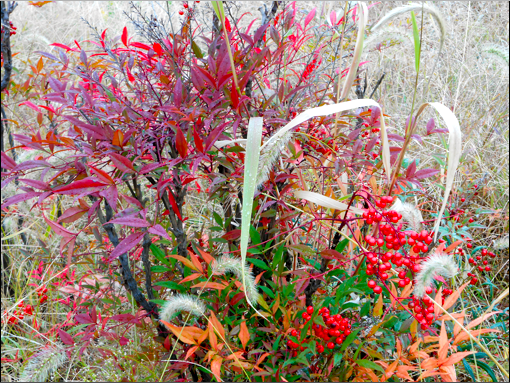 |
| Wild Japanese flower arrangement |
 |
| Japanese backyards |
 |
| sleepy dog and persimmon tree |
Another thing happens on days when HPAC has a quiet schedule, something I've seen on occasion. In late afternoon the children appear, playing in the trees outside my window.
 |
| Children on tree tops |
It's a strange world, Japan. So many things unexplained. How did Mormons get here? How do Japanese weeds grow so beautifully? Why are there children in trees?
Sunday, November 4, 2012
Kaneko-san and Beethoven
My weekly Japanese lessons have started to take on a predictability, a pattern, a routine. I'm not sure what Kaneko-san has in mind coming into it, but from my end I like to stay a chapter ahead of where we are in the lessons so that the lesson of the week is a review. At this point, the material isn't too challenging. I don't understand Japanese, but I do understand Minna No Nihongo (Everyone's Japanese), my textbook. It's like a children's book which says the cow jumped over the moon and I just believe it until I get to the point where the world asks otherwise of me. I like children's books.
But because the exercises are not very difficult, it doesn't take much for me to read them quickly and feel ready to move on. Kaneko-san still likes to emphasize things, rereading and stressing certain syllables. The COW jumped over the MOON. Mmmm, yes, wakarimashita, I understand. It's great to hear a native speaker say these things and to remind me of when to pronounce numbers in different ways depending on their context (9 is "kyu," unless it's referring to 9 o'clock in which case it's "ku, " and numerous other situations often with 6 or 8 complicit), but I'm discovering that the real fun time in the lesson, at least for me, is when Kaneko-san trails off from the exercise enough that I can hand him my sakubun, my essay. It's during this point that we get to start a long exchange of near hits and misses of understanding.
Usually the essay just talks about something from my week, or weekend, or about my daily routine. This week I wrote about the concerts that we are playing and that I like Beethoven. And with this a discovery of something common in our blood. I'm not surprised that Kaneko-san likes Beethoven. Just as I'm coming to understand Japanese more and more each week, I'm coming to understand my dear teacher, and to have some set of expectations for his behavior. When he read that we were playing the 7th Symphony he found the word in the dictionary for "nature." "Ah," I said, "Roku ban," (the sixth). He looked at me a little confused. I hummed the pastoral opening of Beethoven's Sixth Symphony and his face lit up as he exploded with excitement. "Hai, hai!" he said. I feel the same way about that melody and getting to sing it in my Japanese lesson.
It feels so satisfying to get a little closer to someone. Both Kaneko-san and Japanese are a mystery that are slowly revealing themselves to me, one intertwined with the other. Every week we get a little bit closer to an unreachable goal, like a Zeno's paradox (only I don't think my ignorance has a weekly half-life.) I don't think the progress is measurable, but that doesn't mean that it doesn't exist and isn't quite enjoyable in the process.
But because the exercises are not very difficult, it doesn't take much for me to read them quickly and feel ready to move on. Kaneko-san still likes to emphasize things, rereading and stressing certain syllables. The COW jumped over the MOON. Mmmm, yes, wakarimashita, I understand. It's great to hear a native speaker say these things and to remind me of when to pronounce numbers in different ways depending on their context (9 is "kyu," unless it's referring to 9 o'clock in which case it's "ku, " and numerous other situations often with 6 or 8 complicit), but I'm discovering that the real fun time in the lesson, at least for me, is when Kaneko-san trails off from the exercise enough that I can hand him my sakubun, my essay. It's during this point that we get to start a long exchange of near hits and misses of understanding.
Usually the essay just talks about something from my week, or weekend, or about my daily routine. This week I wrote about the concerts that we are playing and that I like Beethoven. And with this a discovery of something common in our blood. I'm not surprised that Kaneko-san likes Beethoven. Just as I'm coming to understand Japanese more and more each week, I'm coming to understand my dear teacher, and to have some set of expectations for his behavior. When he read that we were playing the 7th Symphony he found the word in the dictionary for "nature." "Ah," I said, "Roku ban," (the sixth). He looked at me a little confused. I hummed the pastoral opening of Beethoven's Sixth Symphony and his face lit up as he exploded with excitement. "Hai, hai!" he said. I feel the same way about that melody and getting to sing it in my Japanese lesson.
It feels so satisfying to get a little closer to someone. Both Kaneko-san and Japanese are a mystery that are slowly revealing themselves to me, one intertwined with the other. Every week we get a little bit closer to an unreachable goal, like a Zeno's paradox (only I don't think my ignorance has a weekly half-life.) I don't think the progress is measurable, but that doesn't mean that it doesn't exist and isn't quite enjoyable in the process.
Saturday, November 3, 2012
Friday, November 2, 2012
Missing
What is missing when we miss something? What changes when it reappears? Is it a matter of practicing patience in its absence? Of remembering more vividly, of living it internally, with trust that it continues to live beyond the realm of ready perception? There are people, there are voices, there are bodies and places that I miss seeing, that I miss hearing, that I miss sensing. But they are still there. The rush of their presence, in some shadow form, after waiting outside the door for an eternity, reminds me that they are always there, seen or unseen. And it is only my forgetting that makes them so far away. But I am human. And sometimes I am filled with only the walls around me that have yet to be covered. But they will be. And the world from before, its people, its voices, its places, will always be. I cannot lose them. Maybe our world grows larger the more that we miss.
Thursday, November 1, 2012
Human Exchange
This week we have the privilege of Beethoven's company. How many times have I helped bring the silent score of the Seventh Symphony to life? And each time is different, each time getting to know this man more intimately and in a new light, accentuated by the people around me with whom I share the privilege. Like reading a poem in the morning, and then before bed, and then 20 years later. Always the same words, but the author changes with the reader's passing time. Is an author only one person? Do their words "mean" only one thing? And the reader becomes aware of their own change through the change in something so steadfast. How permanent is pen to paper? How many angles can a person have? How often do we have the chance to explore them in such a way? An anonymous dance of self-emergence through the act of creation and reception.
There are so many ways to listen. A difference in the color of a wind solo, the way my stand partner plays a rhythm, the unpredictability of a soloist's timing, the conductor's insistance on special dynamics. And all these things somehow conspire to breathe new life into someone no longer living except through us and our human quirks. Music is a pretty cool thing.
There are so many ways to listen. A difference in the color of a wind solo, the way my stand partner plays a rhythm, the unpredictability of a soloist's timing, the conductor's insistance on special dynamics. And all these things somehow conspire to breathe new life into someone no longer living except through us and our human quirks. Music is a pretty cool thing.
Subscribe to:
Posts (Atom)