Friday, September 7, 2012

Nishiwaki walk

The orchestra tends to have rehearsals from 10:30 am- 4:30 pm.  This may seem like a lot but with a 75 minute lunch break and two 20 minute breaks, it's only slightly over four hours of actual rehearsal.  The rest of our time is ours.  This leaves time for exploratory walks.

Close-up of rice, growing in its flooded field

Guard of the shrine- ready for a meal?

Japanese Cemetery

Shinto shrine in Nishiwaki; this is the hondon where the spirit is enshrined;  according to wikipedia, shrines often exist in networks which share the same spirit, and according to descriptions of shrines on wikipedia, I think this one might be to Inari (http://en.wikipedia.org/wiki/Shinto_shrine)

entrance to walk up the mountain; most likely this is a shrine whose spirit is contained within the mountain and there are likely other shrines along the path; it was getting dark so I didn't go up all the way

right outside the hondon

these two pictures leading up to the shrine reminded me of the Creation Museum in Kentucky, but a little bit different; perhaps it is in their suggestive rationale; I think it's more fun not knowing what the Japanese means and I encourage you to find your own explanation

A car, a broken guardrail, a happy man emerging from the car in the tree.....and a flaming god;  apparently, according to a friend this is a shrine for drivers. Fudo-myoo is a Buddhist deity (wisdom king) who cuts through delusion, and is often the focal point in many shrines and temples

I almost bought this but think I will give my stomach a few more weeks to become slightly more adjusted
I came home and watched Japanese baseball while eating "seafood noodles,"  and renken chips.  Japanese baseball appears to be far less polished than American baseball.  Pop-up balls fall to the field and batters swing at balls that hit the dirt.  But it makes for a great game.  They even have cheerleaders and when someone gets a home run they are greeted with a giant stuffed animal (?) as they cross the plate.  Hoping to get to a live game before the season ends.

Tomorrow we have a performance of Tchaikovsky's Serenade for Strings and Dvorak's Symphony from the New World.  It's been fun to rehearse and to hear the colors of the orchestra.  And it's been nice to explore another corner of Japan.

Thursday, September 6, 2012

Taka-cho

Today we started a three day visit to Taka-cho, a small town about 2 hours away from Takarazuka.  We came by bus through the country hills filled with rices paddies and small homes and arrived at the hall where we'll be performing.  After our rehearsal, the people in the town held a reception at the hall which included delicious food, an amazing Taiko drum performance, and mochi making.  


the bus to Taka-cho
Verde Concert Hall in the middle of rice paddies

Taiko drumming
Pounding rice to make mochi

After taking my turn pounding the rice, I picked up the delicious fruits of our labor, seen here in the foreground

Our conductor, Maestro Sato, making mochi


Wednesday, September 5, 2012

Laban in Japan

What is sincere communication?

Do I know what I'm saying when I speak and do I really listen when others speak?   Or have our words fallen into such a predictable pattern that we speak in parallel lines, never intersecting?

Tonight we had our first concert at HPAC.  It was a string chamber orchestra concert and we played in a recital hall which surrounded our tightly packed stage with a tightly packed audience.   We all entered together, rather than warming up individually on stage, and the affect was that we and the audience met each other in our entirety.  I looked out to a sea of beautiful Japanese faces, waiting to share something with us in such close proximity.

Why is music important?  What is it that makes people come to hear us and what is it that makes us want to play?

In daily conversations, there are certain words and phrases and breeches of privacy which are appropriate, and others that are not.  Are we listening, or just filling in the space?  Is it enough or do we want more?

I think that people want more.  I think they want to know one another and to be known.  But it is so confusing, all the words that define us so inaccurately.  The words that make us think that a day was good or bad, or that we or other people are one way or another.  For the sake of clarity we have created a black and white space with our words and we communicate through it, but how can this satisfy our inner needs which are far more nuanced?

I feel like most of my endeavors in life have some impetus from wanting to be closer to people.  I will always occupy my own body and be myself and nothing can physically change that fact.  I can be no other than me.  But I have always been curious about other people.  I even remember when I was very little, wanting to be another person, just out of curiosity.  What is it like?  Who are the people around us?

It is a privilege to be a musician, especially in a time when I am struggling to communicate through language with the people around me.  Language is so valuable; but in the face of the power of music, I am reminded of its shortcomings and abuses.  I want to learn Japanese, but tonight reminded me that I can cultivate a sincere communication with those who want to listen.  And I can listen to them listening.  I can listen to them wanting and needing a deeper sense of belonging than daily language can express, transcending the space between one person and another.


Tuesday, September 4, 2012

Night Rice Paddies

Japan is a magical place.  I don't think it will ever fully reveal itself to me.

A new friend took me on a walk to discover some open spaces in the neighborhood, something not so easy to find in Japan.  We walked through playgrounds and gardens and areas of respite, all along the reflective water and then down a little alley into the rice paddies.  Grassy stalks in water and our little path cutting through them in the night, the smell of rice unveiling.

Sometimes, in this new place, I can feel myself put up a protective wall.  I can feel myself holding on to the way that "I" am, things that I need and values by which I live.  And I've felt these clash with Japanese values or with the Japanese way of living.  These range from the personal inconveniences of 6-way garbage sorting to the feeling of relinquishing some of my personal individual expression for the sake of not offending anyone.  But as I let down the wall I see more clearly what had caused me to reflexively clinch and it invites more curiosity.  I haven't bought aluminum foil for cooking because it's too much hassle to dispose of it properly.  The same of plastic bags and paper towels.  The garbage system disincentivizes consumption and I've started to ask myself what it is that I really need, and what can I avoid consuming.  My fear of personal expression has led me to look more closely at the people around me and to see how varied they are as individuals.  I've come to appreciate the many ways that they express themselves and I look to them for encouragement in my own personal expression as I try to be respectful of the rituals and expectations of their culture.

I'm aware that I'm a child here.  A child doesn't yet know that some things are good and others are bad until someone tells them so.   As Japan slowly becomes more familiar to me, as I come to learn more verb conjugations and subway lines, I want to take the opportunity to observe what this culture prefers and how it acts without assigning a right and wrong to it.  As an outsider I have the liberty to observe without becoming immersed.  

But for this reason I wonder if I inherently relinquish my ability to ever fully touch Japan.  If I live Japan objectively, it is not a subjective experience.  The thing that clouds our own culture from ourselves is also what makes it a part of us.  I know that I'm American, but I don't know that I will ever really understand what that means or what that is.  It's just something in me.

And yet we can cultivate something without it losing its mystery.  How is this so?  We come to know another person, and we come to know that they can never be fully known to us.  We come to know a piece or a poem or a painting, and yet it is still more and more magical.  I've been a musician for over two decades and I still don't understand it.  Perhaps what there is to understand simply becomes larger the more I open myself to it.

And so I think I can try to put down the protective wall that wants to keep myself intact and keep Japan an objective magical mystery.  I think I can open myself to it more fully without the danger of either of us losing ourselves.

Monday, September 3, 2012

First day of rehearsal

I'm not sure what it is that has gotten me here.  I'm not how it is that I'm deserving, but I feel that I must be accruing and collecting so much karma of which I'm obligated to share with the world.  That I can make sound with other people, that I can learn from other people.  The concertmaster of the Philadelphia Orchestra is leading us, and we also have the wisdom of the former first violist of the Los Angeles Orchestra.  And after morning and afternoon rehearsals, I had a lesson with the former principle of the Bavarian Radio Symphony Orchestra.

Just as Japan is new to me, this musical world is new.  At this point I don't really know what to say other than I believe that I will learn as much from it as I will from the Japanese culture around me.  I'm sure at times I will be frustrated in rehearsals, or tired, or hungry.  But there is no way to ignore that it is a privilege to be playing with these people- that I am being paid to make music and to learn.  I feel great gratitude and responsibility- it's too much for one person.

Sunday, September 2, 2012

Time and Space

There is a lot to process.  It seems like every few days I have a mini-meltdown and then rebuild within a few hours and find myself in a new mental and emotional place.  Soon the sand will settle and I'll come to terms with the elements that make up Japan.  But there are a lot of them.  Two days ago I had to process earthquakes and what it is to live with a backdrop of understanding that extreme disaster may be only seconds away.  In western countries we come to accept the risk of cars and planes and saturated fat and just we swallow it and in Japan I suppose one comes to assume other risks. Life is life and it goes on and I signed up to play in a masterclass to distract myself from things I can't control.  

Another ongoing adjustment is noise and how much noise I feel I need to make in life.  I'd never thought I was a loud person, or a big person, or a clumsy or especially messy person, but living in Japan has giving me a new calibration.  I like to practice cello and that makes noise, but that's an understandable thing for an orchestral member to do and we have a sound proof room for it.  But I also like to practice Tae Kwon Do and this is something that I'm having a hard time finding the physical and respectful space to do as it can be somewhat noisy.  

I woke up this morning and thought about the long meeting of yesterday and I reflected on the value of this country for efficiency of a different kind than that to which I'm accustomed.  In America we value efficiency of time, and in Japan they seem to value the efficiency of doing something well and without waste.  Spending time to do something the right way rather than cutting corners to get it done.  There are so many plans and plans for plans and then different copies and ways of organizing all these plans and in the end there is something that is very efficient though the process is not really that way.  It's a strange thing to get used to but it's made me reflect on the way that Americans (and I'm sure others) can hoard their time and become stressed by it.  We eat fast and drive to avoid the inconvenience of waiting for public transportation.  We'd prefer to give individuals time on their own to more efficiently work on a project rather than have a group meeting to hack things out together.  The offices at Hyogo Performing Arts Center are all in one room with a bunch of desks- no walls, no cubicles- as though the people working there are all one machine.  

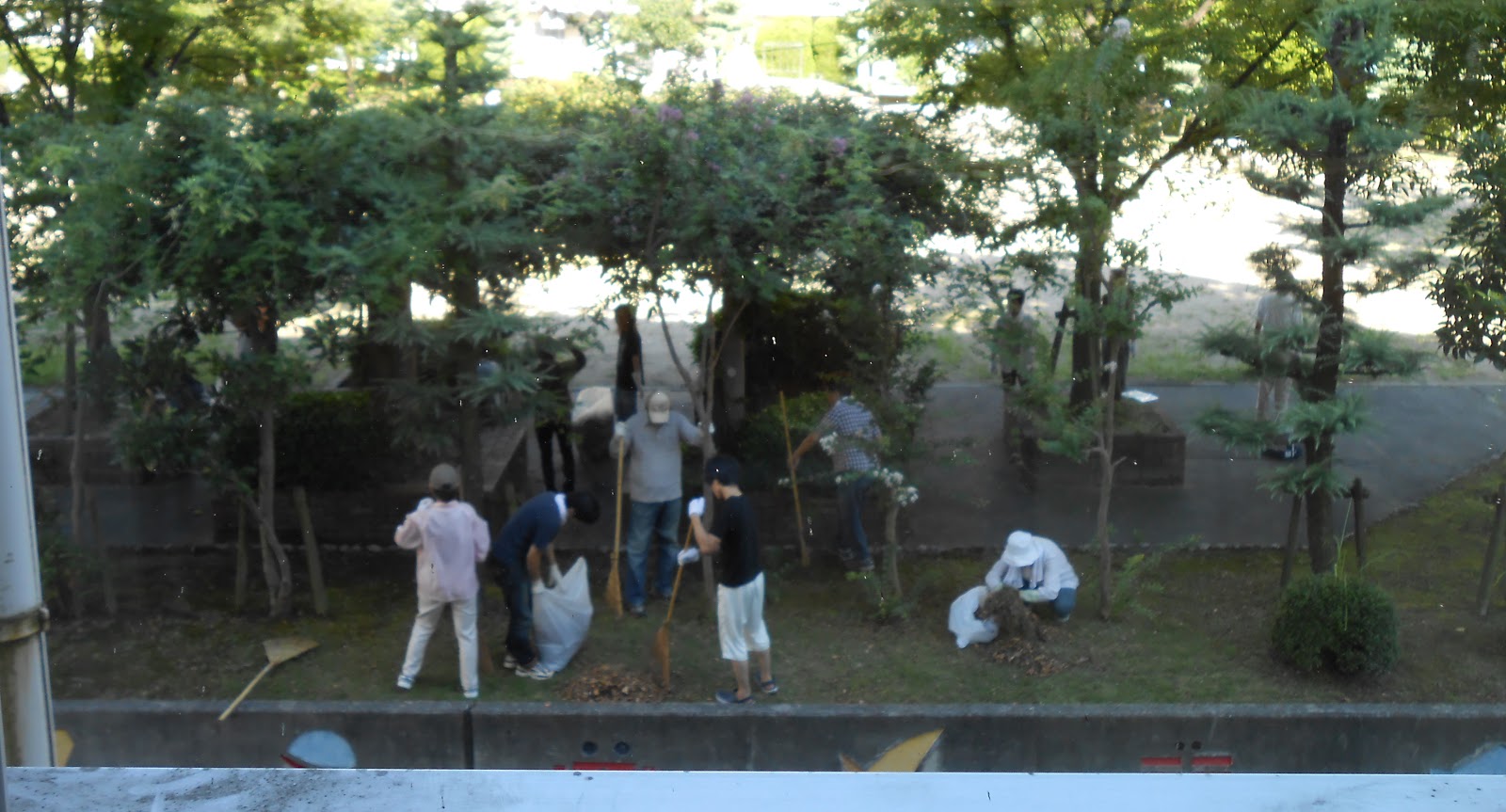
I went into my practice room this morning to practice Tae Kwon Do and once again felt concerned about the noise of jumping and keehopping.  I decided to do the warm-ups with no jumps, reduce the volume of the keehops, and then go outside for kicks, kicking combinations, and forms.  But after my warm-up I looked outside and on this Sunday morning at 8 am, the neighbors were out and about.  They were cleaning the small playground area and streets around the apartment, brooms and rakes in hand.  I watched a woman carefully sweep the gutter of the street, draining the water from the dust pan and collecting all the leaves to be thrown away.  I couldn't go out and practice in the face of their work.  But I couldn't practice inside either, for my growing respect for their space and the care they put into it.  I wanted to join them, but even this felt disrespectful.  So I took the place of the crows on the top of the buildings and watched them do the work that they knew so well, and talk to one another, caring for their space together, early on a Sunday morning.


Saturday, September 1, 2012

Organizing time

We had a four hour orientation meeting today.  It was a very zen experience.  Questions answered that I never would have asked and things were clarified that I had never thought to consider.  They gave us rules and strict protocol but told us we should disregard them if the situation required otherwise.  

What can we assume is commonsense?  How much can we assume that we can trust one another to behave in an appropriate manner?  What can we assume another person comprehends?  Perhaps the answer is that we should not assume any of these things and that is why we have four hour meetings that seem incredibly redundant but in reality just ensure that there are no assumptions.  We should come to rehearsal and not pretend to be sick.  We should bring a pencil and it should not be hard lead because it will dent the paper.  We will get paid to be there but not if we aren't there.  They will pay for our transportation but only if we are working for them.  So many things can fall through the cracks of translation and cultural expectation and I suppose it is important for redundancy to catch them.  It tests my patience and my desire to own my time and be in control of my time.  But that is something that people here seem to relinquish quite frequently in favor of the group task.  I've seen this done on my behalf and the behalf of others numerous times.  Despite the incredible level of organization and communication redundancy that occur, and despite the expectation that rules will be followed or you may risk offense, I have been struck by how flexible the plans can become if something does not happen as originally outlined.   People and the group are the most important thing in the end.  Maintaining good relationships is important and these rules and organization are to help those relationships have some foundation and common ground.  They are about respect in a way.  And because this is so important, it should be clearly outlined at the risk of redundancy.  Perhaps there are other reasons for this type of meeting.  I'm sure there are other reasons of which I haven't thought.

In America, it would be far more to the point, far more would be assumed, and the outcome would be sloppier.  Perhaps people would get offended in the places where rules were not firmly established and they would gripe about it or swallow it and wonder why it bothered them.  It's just a different way of group operation.  And it is one that I need to get used to.  I wonder if I will have a self by the time I leave Japan.