It seems that the orchestral model for classical music is being tested right now. So many stories in the news of contract negotiations that couldn't find the proper intersection of money, time and rights. Once again it brings the question of value to mind. What is the value of classical music? Why is it important? Can it serve a purpose other than background music for sushi?
This evening I enjoyed a concert of chamber music on the 9th floor of building in Kobe at Pia Julien, Tearoom and Shotbar. It was organized by members of HPAC, and the venue is a frequent host of chamber concerts. It was a chance for me to watch "Classical Revolution" from the outside, as neither a player nor an organizer. And it made me think about the value of the experience, both to the audience members who paid to be there and the musicians who took away little.
How often are we given the time and the space to listen, and how often do we have a chance to hear ourselves and to cultivate what it is that we desire to communicate? We speak so many words during the day: what are they saying? Perhaps it is impossible to fully communicate oneself or to fully listen to another person, to listen beyond words and gestures. It takes a dedicated time and space, a willingness on the part of the giver, as well as the receiver.
Is this something of value? What can we gain from it and how can it affect our lives? How can we sustain it?
Tuesday, October 2, 2012

Monday, October 1, 2012
Blind Distance
Some things exist beyond circumstance. Sometimes we are far away from a place or a person or who we are. When we blink, do these things still exist? And while we sleep? Does a juggler watch every ball at every moment?
How far away is Japan? By what factor of time and space have I removed myself from myself, from people I care about, from places in which I'm familiar? What will transcend this distance? I think there is something to learn of trust in this. Even in times of being close, what gives us the trust to feel that something is real, that a person or an ideal is integral to our being? How much of this is something that we can control, and how much of it is something that we can only observe with curiosity and humility?
In any given moment in life, we are removed from the things and the people that are a part of us. Bow hair loosened until the next performance, the unnamed deadline that inspires the act of creation. The person next to us, engaged in a TV show, or in the next room, having dinner. Maybe they're driving home, or maybe they won't gather until next Saturday's brunch. Maybe they are across an ocean, asleep while we work. Where are they? How do we know that they are still there?
How far away is Japan? By what factor of time and space have I removed myself from myself, from people I care about, from places in which I'm familiar? What will transcend this distance? I think there is something to learn of trust in this. Even in times of being close, what gives us the trust to feel that something is real, that a person or an ideal is integral to our being? How much of this is something that we can control, and how much of it is something that we can only observe with curiosity and humility?
In any given moment in life, we are removed from the things and the people that are a part of us. Bow hair loosened until the next performance, the unnamed deadline that inspires the act of creation. The person next to us, engaged in a TV show, or in the next room, having dinner. Maybe they're driving home, or maybe they won't gather until next Saturday's brunch. Maybe they are across an ocean, asleep while we work. Where are they? How do we know that they are still there?
Sunday, September 30, 2012
Meeting Noboru Kaneko for the first time
I'm curious to know who Noboru Kaneko is and what brought him to volunteer to teach Japanese at the Takarazuka International Friendship Association. International Friendship. There are so many things to which one can volunteer their time in retirement and he chose this one.
His enthusiasm was endearing and he presented me with two copied pages of text with phrases for introducing oneself, stating and asking one's native country, and asking about one's career. These were romanji versions with English translations along with them and since I've learned this much Japanese fairly well and already been practicing a fair amount of kana, it wasn't a challenge or anything new. I'm an experienced beginner, perhaps one of the most challenging places from a which a teacher can start to teach. I showed him the book I've been working from, which has about 60 pages of kana examples and writing that I've done, covering shopping and telling time and getting directions. He was impressed, but somehow at the end of the lesson he still went over to the copy machine and printed the hiragana alphabet for me. Finally, he "presento shimas" (gave me a present) of a folder in which I could keep my papers.
I left feeling very enthusiastic. He doesn't speak any English at all. I may speak more Japanese than he can speak English. Just as I confidently prepare a Japanese conversation and am surprised when the other person decides to use words other than what I assigned them, I think he had alternate expectations for the hour and the course of study. I can understand. Familiar feelings of frustration arose when he had me read the conversations of introduction, interrupting me as I slowed to make out the superscript kana above the kanji characters. He was very enthusiastic. But I got a lot of value in the interim portions of the lesson, when he would ask me a question about where I'm from or how long I've been here or if I'd been to Japan before. Armed with our respective dictionaries, we had a battle of communication, trying to learn more about one another. At one point he asked if I had studied other languages and I told him I knew a little German and little Spanish. He also knew a little German and from that point on in the lesson we had a Japanese lesson in German. Apparently this was more comfortable for him.
I imagine that I'm going to learn a lot from Noboru Kaneko. Today I learned that he is 7 years past the mandatory retirement age (I tangentially learned that companies in Japan have one), and that he used to work for a marine (?) and fire insurance company. He is from Kyoto. It is a wonderful opportunity to practice Japanese. I'm not sure if it will be be my primary source of learning, though. It wasn't really possible for him to assign me a book to purchase or homework to study. I'm not sure how he would have been about to communicate this and I think he was surprised at how much I had done on my own, despite being a beginner. We'll see where things are next week.
My friends has agreed to be an unofficial tutor. She is an American and avidly studies Japanese, mastering what I consider to be an incredible amount for one year. After our lessons we went to the bookstore and I purchased some new books from which to practice. I'm looking forward to availing myself of so many friendly resources. And now to study, study, study.....
His enthusiasm was endearing and he presented me with two copied pages of text with phrases for introducing oneself, stating and asking one's native country, and asking about one's career. These were romanji versions with English translations along with them and since I've learned this much Japanese fairly well and already been practicing a fair amount of kana, it wasn't a challenge or anything new. I'm an experienced beginner, perhaps one of the most challenging places from a which a teacher can start to teach. I showed him the book I've been working from, which has about 60 pages of kana examples and writing that I've done, covering shopping and telling time and getting directions. He was impressed, but somehow at the end of the lesson he still went over to the copy machine and printed the hiragana alphabet for me. Finally, he "presento shimas" (gave me a present) of a folder in which I could keep my papers.
I left feeling very enthusiastic. He doesn't speak any English at all. I may speak more Japanese than he can speak English. Just as I confidently prepare a Japanese conversation and am surprised when the other person decides to use words other than what I assigned them, I think he had alternate expectations for the hour and the course of study. I can understand. Familiar feelings of frustration arose when he had me read the conversations of introduction, interrupting me as I slowed to make out the superscript kana above the kanji characters. He was very enthusiastic. But I got a lot of value in the interim portions of the lesson, when he would ask me a question about where I'm from or how long I've been here or if I'd been to Japan before. Armed with our respective dictionaries, we had a battle of communication, trying to learn more about one another. At one point he asked if I had studied other languages and I told him I knew a little German and little Spanish. He also knew a little German and from that point on in the lesson we had a Japanese lesson in German. Apparently this was more comfortable for him.
I imagine that I'm going to learn a lot from Noboru Kaneko. Today I learned that he is 7 years past the mandatory retirement age (I tangentially learned that companies in Japan have one), and that he used to work for a marine (?) and fire insurance company. He is from Kyoto. It is a wonderful opportunity to practice Japanese. I'm not sure if it will be be my primary source of learning, though. It wasn't really possible for him to assign me a book to purchase or homework to study. I'm not sure how he would have been about to communicate this and I think he was surprised at how much I had done on my own, despite being a beginner. We'll see where things are next week.
My friends has agreed to be an unofficial tutor. She is an American and avidly studies Japanese, mastering what I consider to be an incredible amount for one year. After our lessons we went to the bookstore and I purchased some new books from which to practice. I'm looking forward to availing myself of so many friendly resources. And now to study, study, study.....
Saturday, September 29, 2012
Wadayama day tour
Today the HPAC orchestra visited the small town of Wadayama to perform a concert. Two hours northwest of our Takarazuka home, our day trip introduced us to new places and faces, foods and phenomenons.
After about an hour on the bus, we stopped for a short break....
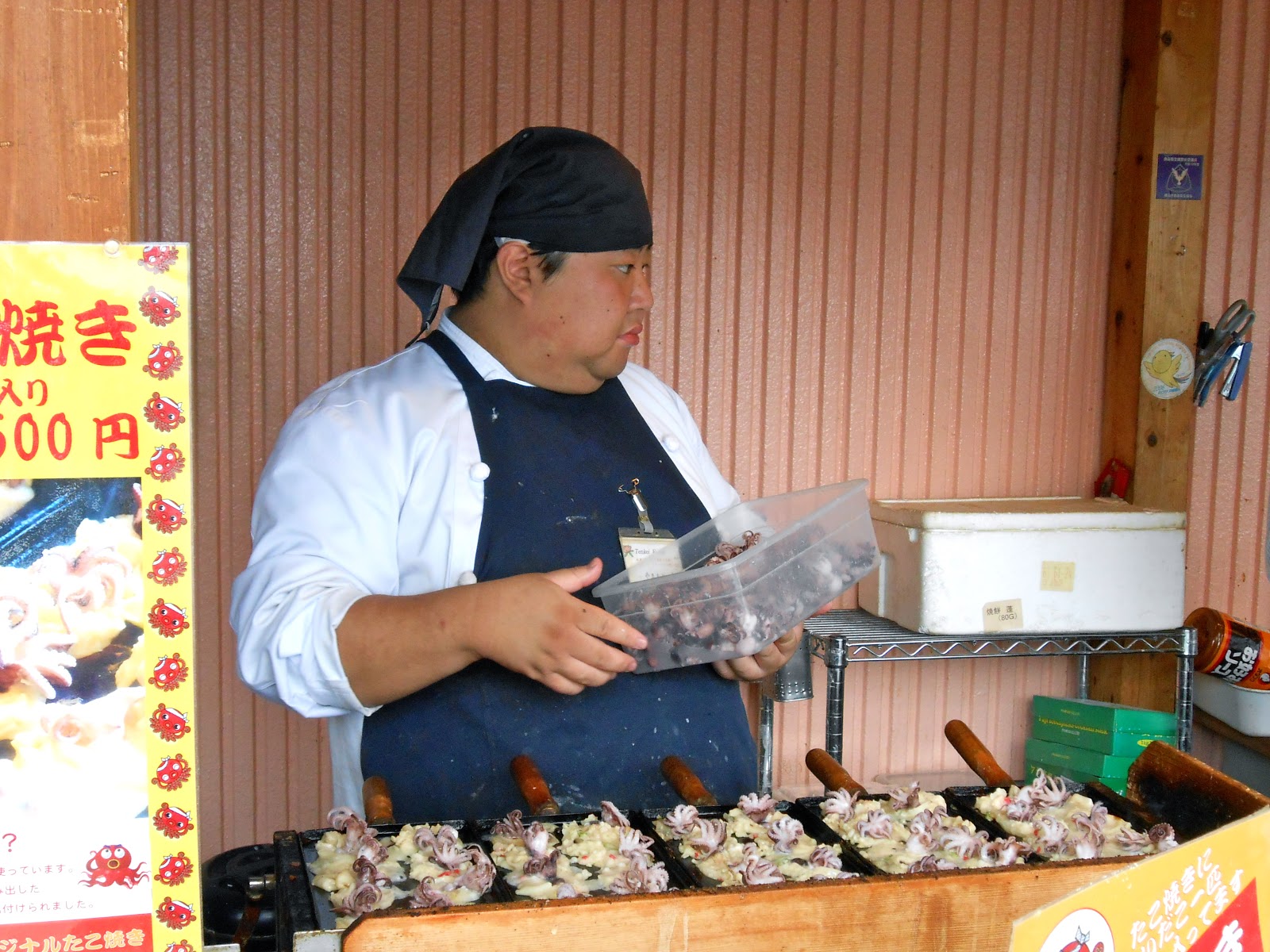 |
| The takoyaki man at the rest stop, yaking his tako. |
 |
| Information guide for toilet stall type and availability in the women's restroom |
When we arrived in Wadayama we were greeted by a billboard for our concert. Our conductor was very intense.
 |
| Guitar soloist (left) and conductor (right) for our concert in Wadayama |
Beyond their welcoming gaze lay the gateway to autumn and to Jupiter Hall.
 |
| The first (and only) changing leaves of Hyogo thus far |
Lunch time brought about an obvious choice:
 |
| The Big Bang Family Restaurant |
I wouldn't say that it is impossible to eat poorly in Japan, but I think it's a lot harder than America. Or perhaps it's the novelty fairy painting the world like candy. Regardless, for about $5.50 I had this delicious lunch of "egg."
 |
| Egg with onions, herbs, spices, seaweed and fish cake over rice; and miso soup |
The concert was an interesting experience, one quite foreign from the typical HPAC concert. Normally we play to a huge sold-out hall for an audience that will clap the encores out of us, but never stand up. Today's much smaller "Jupiter Hall" could not encourage the town fill it to one third of its capacity and this included the junior high school students with whom we shared the program. They didn't clap long enough for the guitarist to play her encore and they stopped clapping at the end of Carmen before the orchestra could even stand up. But perhaps this was due to some confusion because at the very end of the concert, after Bolero, they continued to clap; and although temporary and shy, two individuals rose in standing ovations. It was really sweet to see two people in an audience of 200 do something that no one in an audience of 2,000 would brave to do. And it was encouraging. It's really rewarding to play for a full house and much more difficult to play for empty seats. Should it matter? Regardless of how it effected our performance and whether or not it should, I welcomed the warmth of the uncommon ovation.
After a rainy bus ride home, some friends invited me to a coupon subsidized dinner of okonomiyaki. Sometimes I regret putting that sign on my mailbox requesting relief from junk mail. Is it really junk if it can bring about this culinary bliss? I wish I had enough Japanese to modify the sign so that it would include incredible coupons to delicious restaurants within walking distance, but I'm afraid that by the time I acquire such linguistic acumen I will no longer be forgiven the gaijin (foreigner) transgression of such a request. Luckily, I have wonderful friends.
 |
| Anahid (left) and Bernice (right) enjoying okonomiyaki |
 |
| Detail of a thick okonomiyaki (egg, noodle, and in this case, seafood pancake)- Osaka style |
At the moment, I am still quite full.
Friday, September 28, 2012
Ohayo Gozaimasu
I woke up a little behind the beat this morning. Some mornings are like that. Maybe it was an excess of frozen seafood and soba noodles or a new angle to the sun in my room which opened my eyes a little more slowly. Lingering conversations or dreams, it's hard to say.
Despite my tepid attitude I biked to the river to do a morning Tae Kwon Do practice. It's been interesting to be my own teacher, especially in times like these. In class there was a start time, and a group voice, and instructors pushing me to do more than I thought I could do physically and mentally. At every belt test, I learned something about myself from the challenges that I overcame. But here, a silent reflective river awaits me in the morning. A new sort of challenge.
This morning I didn't feel moved to kihop fully. I had a new type of practice, partially inspired by this new mood, partially so as not to disturb the dog across the way that kept barking. While I generally don't shy from communicating with a canine friend, I decided to try a mostly silent practice. I thought about the value of the kihop, it's something that I've thought about a lot here. In a solo practice, why is it important to express the fullness of one's voice?
As I biked towards the hall, I remembered a previous belt test in which I witnessed a mental discipline exercise that one of the red belts had to perform. In the plank position with his fists in two bowls of snow, he had to instruct a white belt how to do a side kick. At the time, I just thought this was super hardcore. I didn't realize that perhaps there was something else being taught and tested here. Something about inner resources and limitations and offering the full extent of one's being to others.
Why do we say good morning when we see one another? Does the sincerity with which we say it affect us? Does it affect others?
I feel lucky to be a musician. On days when I'm on the backside of the beat, I can go into a rehearsal and experience the expression of those around me. And I can offer an expression to them, with all the resources that I have that day. And somehow, they grow. Something in the act of offering actually increases these resources. It is a reminder that they exist, not just for those to whom they are given, but for the giver.
The people in this orchestra feel like a family. Perhaps it's the nature of our rehearsal and performance schedule, or the fact that many of us are living in a home far away from family and friends and the comforts of our native culture. We live together and play together, and commute by trains and bikes together. Like family, we can't lose one another. And maybe for this reason it feels even more personal to play music together. It isn't instruments to which I listen or with whom I play, but people. I hear my friends and I play with them. I can share a voice with the same people to whom I say good morning.
Some mornings it is harder to kihop fully, harder to say hello and meet someone's eyes, harder to listen, to give and receive. If it is harder, is it impossible? And why does it matter? What is the value of expression? Why is it important and how does it affect us? How can we share more of ourselves, more fully? Why should we try to do this, and for whose sake?
Despite my tepid attitude I biked to the river to do a morning Tae Kwon Do practice. It's been interesting to be my own teacher, especially in times like these. In class there was a start time, and a group voice, and instructors pushing me to do more than I thought I could do physically and mentally. At every belt test, I learned something about myself from the challenges that I overcame. But here, a silent reflective river awaits me in the morning. A new sort of challenge.
This morning I didn't feel moved to kihop fully. I had a new type of practice, partially inspired by this new mood, partially so as not to disturb the dog across the way that kept barking. While I generally don't shy from communicating with a canine friend, I decided to try a mostly silent practice. I thought about the value of the kihop, it's something that I've thought about a lot here. In a solo practice, why is it important to express the fullness of one's voice?
As I biked towards the hall, I remembered a previous belt test in which I witnessed a mental discipline exercise that one of the red belts had to perform. In the plank position with his fists in two bowls of snow, he had to instruct a white belt how to do a side kick. At the time, I just thought this was super hardcore. I didn't realize that perhaps there was something else being taught and tested here. Something about inner resources and limitations and offering the full extent of one's being to others.
Why do we say good morning when we see one another? Does the sincerity with which we say it affect us? Does it affect others?
I feel lucky to be a musician. On days when I'm on the backside of the beat, I can go into a rehearsal and experience the expression of those around me. And I can offer an expression to them, with all the resources that I have that day. And somehow, they grow. Something in the act of offering actually increases these resources. It is a reminder that they exist, not just for those to whom they are given, but for the giver.
The people in this orchestra feel like a family. Perhaps it's the nature of our rehearsal and performance schedule, or the fact that many of us are living in a home far away from family and friends and the comforts of our native culture. We live together and play together, and commute by trains and bikes together. Like family, we can't lose one another. And maybe for this reason it feels even more personal to play music together. It isn't instruments to which I listen or with whom I play, but people. I hear my friends and I play with them. I can share a voice with the same people to whom I say good morning.
Some mornings it is harder to kihop fully, harder to say hello and meet someone's eyes, harder to listen, to give and receive. If it is harder, is it impossible? And why does it matter? What is the value of expression? Why is it important and how does it affect us? How can we share more of ourselves, more fully? Why should we try to do this, and for whose sake?
Thursday, September 27, 2012
Same River
The weather here is becoming so wonderfully beautiful. Biking to the hall in the morning is elating, watching the morning sun on the water and flying through the air. Why is the sun on the water so beautiful? Today I watched it and imagined that I was in the middle of the inevitable coming winter. The sun will still shine on the river, but will it look the same? Will it feel the same? I tried to imagine. Perhaps it will be a different feeling in my shoulders, that familiar narrowing of the chest in defense against the cold. Will I still have the time in my bones to love it? Will the cold air rob me of that pleasure for several months?
What can hurt us? Is it really the air that is so harmful in the winter, or is it our reaction to it? After biking to the hall, I was in a very bluebird mood and hummed my way to the shower room. I discovered that a very thorough Japanese janitor had beat me at my game and removed the towel, soap and razor that I had stealthily left in one of the empty lockers. No matter, on such a beautiful day, who needs any of these things. In fact, isn't it such a lovely lesson to remember that we don't need them? Perhaps I won't bring a new towel, or soap for that matter. Somehow the weather had fortified me against irritation.
As the sun gives us fewer of its precious hours, karmically allocating them to other parts of the world, I know that it will be harder to stay fortified. Things creep in as the air gets cooler and the days become darker. It's a change that is so slow as to be unnoticed. I love the seasons. I love living each one every year. Each has something to offer, whether it is youthfulness, contemplation or the anticipation of something new. What will winter here be like? It won't have the snow of Madison to augment the sun's rays, but it seems possible that I will be able to enjoy a daily bike ride for its duration. Slowly, over the next few months, that will become a different experience. Some days it will be a struggle with cold and wind. Some days I will be tired, my body wanting to rest with the sun. Somedays I will be lonely, in need of warmth to open my ribs and release my defensive shoulders. Somedays will be unfocused, undisciplined, somedays full of doubt. These days, these hours and minutes are there in life. But also there are the moments of sun on welcoming water. Perhaps I can remember it in those times, and fortify myself. Or perhaps I can enjoy the feeling of being unfortified. Laying down my defenses against the feelings of the winter and opening my chest to them. Some days are easy, and some are harder. What can we learn from those easy days? What can we learn from the difficult ones?
I'm looking forward to the fall. Everyone says that it is really beautiful here, and even though the air has taken on its quality, there's very little hint of the leaves departing from their summer home. It's cool and green and I can tell that it will be a long season. In my stomach is the same strange beautiful feeling of uncertainty that I have known my whole life. And this year it is mixed with the uncertainty of novelty. What new things will I come to love in the coming season? Which will challenge me? And will I still see the river the same way every morning?
What can hurt us? Is it really the air that is so harmful in the winter, or is it our reaction to it? After biking to the hall, I was in a very bluebird mood and hummed my way to the shower room. I discovered that a very thorough Japanese janitor had beat me at my game and removed the towel, soap and razor that I had stealthily left in one of the empty lockers. No matter, on such a beautiful day, who needs any of these things. In fact, isn't it such a lovely lesson to remember that we don't need them? Perhaps I won't bring a new towel, or soap for that matter. Somehow the weather had fortified me against irritation.
As the sun gives us fewer of its precious hours, karmically allocating them to other parts of the world, I know that it will be harder to stay fortified. Things creep in as the air gets cooler and the days become darker. It's a change that is so slow as to be unnoticed. I love the seasons. I love living each one every year. Each has something to offer, whether it is youthfulness, contemplation or the anticipation of something new. What will winter here be like? It won't have the snow of Madison to augment the sun's rays, but it seems possible that I will be able to enjoy a daily bike ride for its duration. Slowly, over the next few months, that will become a different experience. Some days it will be a struggle with cold and wind. Some days I will be tired, my body wanting to rest with the sun. Somedays I will be lonely, in need of warmth to open my ribs and release my defensive shoulders. Somedays will be unfocused, undisciplined, somedays full of doubt. These days, these hours and minutes are there in life. But also there are the moments of sun on welcoming water. Perhaps I can remember it in those times, and fortify myself. Or perhaps I can enjoy the feeling of being unfortified. Laying down my defenses against the feelings of the winter and opening my chest to them. Some days are easy, and some are harder. What can we learn from those easy days? What can we learn from the difficult ones?
I'm looking forward to the fall. Everyone says that it is really beautiful here, and even though the air has taken on its quality, there's very little hint of the leaves departing from their summer home. It's cool and green and I can tell that it will be a long season. In my stomach is the same strange beautiful feeling of uncertainty that I have known my whole life. And this year it is mixed with the uncertainty of novelty. What new things will I come to love in the coming season? Which will challenge me? And will I still see the river the same way every morning?
Wednesday, September 26, 2012
Japanese Lesson
I'm learning more and more Japanese. Of my base knowledge of the language, I'd say I'm probably able to access about 30%, and of that I can readily use about another 30% in daily exchanges. So I figure that if I keep increasing the base knowledge, those percentages will slowly become a larger and larger percentage of the expressive capabilities of the Japanese language. Soon I'll be able to order sushi!
It's been an interesting process to go through. I've read about how children start to parse the sounds and syllables of a language and I can identify with that process. I feel as though it is taking a long time just to get accustomed to the possible sound combinations of Japanese. What has been surprisingly helpful, and what speeds up my process of aural deciphering, is becoming more familiar with the kana syllabary (alphabets). As I practice my workbook and become faster at reading, I'm also able to hear words and groupings of sounds more easily. Nice to be able to bring them together, the written and the aural. I'm hoping that the synthesis will just keep getting faster and faster. I start lessons on Sunday!
It's so much fun to decipher this language, through phonetics and context. And I'd like to share just a small portion of the game. There are two large parts to written Japanese. Kanji are the characters derived from Chinese, which are largely phonetic, but also have semantic meaning. Kana is the completely phonetic component of written Japanese.
For instance, the city where HPAC is located is called Nishinomiya, and in kanji it is 西宮市. The first character is "nishi" which means, "west." The second character is "miya" which means "palace." The last is the character for "city", "shi" which may or may not be used when saying the name. The "no" between "nishi" and "miya" is a possessive particle and thus I live in the "Palace of the West (city)." So there are both sounds and meanings to the kanji and they can be rearranged in various ways to make new meanings. Characters can even be squished together to produce new characters.
Kana is composed of hiragana (primarily used for Japanese words) and katakana (used for words taken from other languages). It's fun to sound out words in hiragana, but generally I'm left with a Japanese word that I don't know. It's even more fun to try to figure out words written in katakana, because they might actually be words that I can recognize. But this is essentially the same as shopping at IKEA. Just because you get the right sounds doesn't mean that you will understand the word. It's a lot of fun so here are a few from my workbook decoded from the katakana and turned into "Romanji" (our familiar friendly alphabet), for you to further decipher. Few rules: Rs are hard, similar to a "D" sound; "E" as in "egg"; "I" as "eat." Take your time to sound out each vowel separately. At the bottom of this post are the answers.
Terebi
Rajio
Supa
Depato
Resotoran
Aisukurimu
This says a lot about the way that Japanese hear things. I think that they are very sensitive to vowel sounds and length. For example, the words for beer and building are essentially the same–bidu–but for the alcohol it is biidu. You just hold the first syllable a little longer. So there are shadow vowels in a lot of words that just extend the length a little longer. Verbs often end in what a western ear would hear as "s" but to the Japanese it is "su." They hear and pronounce that extra "u," but it doesn't come as naturally to the western ear or tongue. So much for our superiority complex over "r" and "l."
I hope you've enjoyed this Japanese lesson. It's an increasingly important thing to me for survival (i.e. "I'm going to faint." "Do I take my towel with me to the pool?") as well as being a part of the community ("How are you?" "What did you do this weekend?" "How is your family?" "Did you get rid of that pigeon problem in your apartment?") so I think about it a lot and try to practice in my own introverted way.
And now here are the answers:
Television
Radio
Supermarket
Department store
Restaurant
Ice Cream
It's been an interesting process to go through. I've read about how children start to parse the sounds and syllables of a language and I can identify with that process. I feel as though it is taking a long time just to get accustomed to the possible sound combinations of Japanese. What has been surprisingly helpful, and what speeds up my process of aural deciphering, is becoming more familiar with the kana syllabary (alphabets). As I practice my workbook and become faster at reading, I'm also able to hear words and groupings of sounds more easily. Nice to be able to bring them together, the written and the aural. I'm hoping that the synthesis will just keep getting faster and faster. I start lessons on Sunday!
It's so much fun to decipher this language, through phonetics and context. And I'd like to share just a small portion of the game. There are two large parts to written Japanese. Kanji are the characters derived from Chinese, which are largely phonetic, but also have semantic meaning. Kana is the completely phonetic component of written Japanese.
For instance, the city where HPAC is located is called Nishinomiya, and in kanji it is 西宮市. The first character is "nishi" which means, "west." The second character is "miya" which means "palace." The last is the character for "city", "shi" which may or may not be used when saying the name. The "no" between "nishi" and "miya" is a possessive particle and thus I live in the "Palace of the West (city)." So there are both sounds and meanings to the kanji and they can be rearranged in various ways to make new meanings. Characters can even be squished together to produce new characters.
Kana is composed of hiragana (primarily used for Japanese words) and katakana (used for words taken from other languages). It's fun to sound out words in hiragana, but generally I'm left with a Japanese word that I don't know. It's even more fun to try to figure out words written in katakana, because they might actually be words that I can recognize. But this is essentially the same as shopping at IKEA. Just because you get the right sounds doesn't mean that you will understand the word. It's a lot of fun so here are a few from my workbook decoded from the katakana and turned into "Romanji" (our familiar friendly alphabet), for you to further decipher. Few rules: Rs are hard, similar to a "D" sound; "E" as in "egg"; "I" as "eat." Take your time to sound out each vowel separately. At the bottom of this post are the answers.
Terebi
Rajio
Supa
Depato
Resotoran
Aisukurimu
This says a lot about the way that Japanese hear things. I think that they are very sensitive to vowel sounds and length. For example, the words for beer and building are essentially the same–bidu–but for the alcohol it is biidu. You just hold the first syllable a little longer. So there are shadow vowels in a lot of words that just extend the length a little longer. Verbs often end in what a western ear would hear as "s" but to the Japanese it is "su." They hear and pronounce that extra "u," but it doesn't come as naturally to the western ear or tongue. So much for our superiority complex over "r" and "l."
I hope you've enjoyed this Japanese lesson. It's an increasingly important thing to me for survival (i.e. "I'm going to faint." "Do I take my towel with me to the pool?") as well as being a part of the community ("How are you?" "What did you do this weekend?" "How is your family?" "Did you get rid of that pigeon problem in your apartment?") so I think about it a lot and try to practice in my own introverted way.
And now here are the answers:
Television
Radio
Supermarket
Department store
Restaurant
Ice Cream
Subscribe to:
Posts (Atom)